
The fine print may doom them before they start
A new national standard was supposed to fix how Australia protects threatened species. A single clause has quietly gutted it.
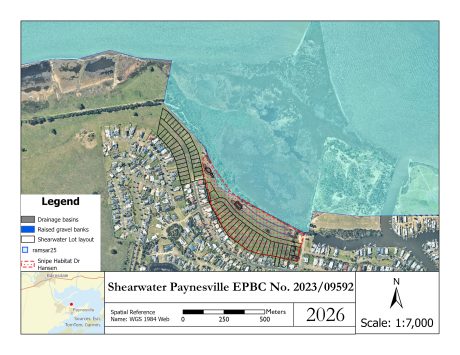
In December 2025, the Federal Government approved development of 10.7 hectares of wetland habitat on the edge of the Gippsland Lakes — one of Australia’s most significant coastal ecosystems — for a 59-lot housing subdivision (see map above). The site contained feeding and roosting habitat for Latham’s Snipe, a migratory shorebird whose conservation status had been upgraded to Vulnerable after the developer’s application was lodged — but well before the Department made its decision.
The developer’s consultants had measured the affected habitat at roughly 1.2 hectares. An independent expert measured the same ground and came up with 6.3 hectares — five times as much. The approval went through. The Department’s reasoning has not been published.
This is not, conservation groups argue, an isolated failure. It is a preview of what Australia’s rewritten nature laws will routinely produce if a critical flaw in a new regulatory standard is not fixed before it takes effect.
What are ‘matters of national environmental significance’?
Under the Environment Protection and Biodiversity Conservation Act 1999 — universally known as the EPBC Act — developers and governments must seek Federal approval before taking actions that could significantly affect certain protected matters. These are called Matters of National Environmental Significance, or MNES.
The list includes threatened species and ecological communities, migratory birds protected under international treaties, Ramsar wetlands (internationally recognised for their ecological importance), World Heritage areas, and nuclear actions. If your proposed development might affect any of them, you need to go through the Federal assessment and approval process.
The EPBC Act has been the backbone of Australia’s national environmental law for twenty-five years. It has also been widely criticised as slow, unpredictable, and — despite its protections on paper — frequently ineffective at preventing environmental harm on the ground.
Why reform was needed
In 2020, independent reviewer Professor Graeme Samuel AC completed a comprehensive review of the EPBC Act at the Federal Government’s request. His findings were damning. The Act was not doing the job. Approvals were taking years. Conditions were routinely not being met. Species continued to decline even after receiving legal protection.
Samuel’s core recommendation was a shift from process-based regulation — where the law requires you to follow steps — to outcomes-based regulation, where the law requires you to actually achieve results. Instead of asking “did the developer submit the right paperwork?”, the new framework would ask “did threatened species habitat actually increase or at least remain stable?”
To operationalise this shift, Samuel called for legally binding National Environmental Standards. The standards would set clear, measurable outcomes that decisions must achieve. They would provide the yardstick against which every approval would be measured.
After years of delay across successive governments, the Albanese Government committed to implementing Samuel’s reforms. A suite of new legislation passed in 2025. The new National Environmental Standard for Matters of National Environmental Significance — the MNES Standard — is the centrepiece. Public consultation on the latest draft closed on 29 May 2026.
The clause that changes everything
Here is where the story turns.
Samuel’s architecture depended entirely on binding outcomes. The whole point was that outcomes could not be overridden by procedural compliance or ministerial discretion. You either achieved the outcome, or the approval could not proceed.
The draft MNES Standard contains a provision — clause 7(2) — that undoes this architecture with a single sentence.
The clause says, in effect, that if a decision-maker applies the Standard’s guiding principles, the Standard’s outcomes are taken to be satisfied. In plain English: follow the process, tick the boxes, and the law deems your development to have protected threatened species — regardless of whether any species were actually protected.
Environmental Justice Australia, which has published a detailed guide on the Standard for community groups and NGOs, describes this as inverting Samuel’s outcomes-first logic. The outcomes become decorative. The principles — which are vague, discretionary, and contain no measurable thresholds — become the operative test.
An analogy from food safety law may help. Imagine a regulation that says restaurants must serve food that does not sicken customers, but then adds a provision saying that if a restaurant follows general hygiene principles, it is deemed to have complied — whether or not anyone got sick. The deeming clause swallows the rule.
The missing floors
The structural problem does not stop at clause 7(2).
The draft Standard, conservation groups argue, systematically removes or weakens protections that the existing EPBC framework already provides in practice. Guidance documents on significant impact assessment, offset policy, and compliance that have been used by regulators, developers, and courts for over a decade are not carried into the new framework. Their removal creates legal uncertainty and, more immediately, an operational vacuum.
The Standard also does not incorporate peer-reviewed science on biodiversity offsets that has emerged since 2020. That research — including a 2025 paper in Nature Reviews Biodiversity — consistently finds that biodiversity offsets, as currently designed and enforced, do not prevent net loss of biodiversity. Researchers argue that offsets, as currently practised, largely convert an approval problem into an accounting problem.
And the Standard does not include measurable, species-specific thresholds of the kind Samuel explicitly recommended in the technical appendices of his report. Without thresholds, there is no reliable way to determine when an impact is significant and when it is not — which is precisely the interpretive gap that allowed two experts to reach figures five times apart on the same piece of ground in the Gippsland Lakes case.
The timing trap
There is a sequencing problem that makes all of this more urgent.
Alongside the MNES Standard consultation, the Government released three additional consultation papers in April and May 2026. These papers propose to commence, on 1 July 2026 — just 33 days after the MNES consultation closes — a new architecture of bilateral agreements with states, Commonwealth accreditation schemes, and a new instrument called a Protection Statement, all of which will operate against the MNES Standard as their reference point for legal consistency.
This means that once bilateral agreements and accreditation schemes lock in against the Standard, the weakness becomes structural and persistent. Review cycles of three to five years mean that a flawed Standard adopted in mid-2026 could govern delegated environmental decision-making until at least 2029 — through years of rapid biodiversity loss during which Australia has committed, under the Kunming-Montreal Global Biodiversity Framework (the global agreement Australia signed in 2022), to halt and reverse biodiversity loss by 2030.
What communities and conservation groups are asking for
The response from the environmental sector has been substantial. Environmental Justice Australia, the Environmental Defenders Office, the Australian Conservation Foundation, WWF-Australia, the Australian Marine Conservation Society and the Biodiversity Council have all called for clause 7(2) to be removed or rewritten in their published submissions. Dozens of regional conservation groups have lodged their own submissions.
The core ask is straightforward: reword clause 7(2) so that the Standard’s guiding principles must be applied in a way that is consistent with the binding outcomes and that promotes the Standard’s objectives. Principles serve outcomes; outcomes do not dissolve into principles.
Beyond that, the community submissions call for measurable, species-specific impact thresholds; a Commonwealth register of cumulative impacts; stronger protections for internationally listed wetlands; and mandatory reassessment when species receive new or upgraded protection listings during the assessment process.
The Gippsland Lakes — the Shearwater development site, home to one of Australia’s largest estuarine systems and a designated Ramsar wetland — sit at the centre of the regional case for reform. The approval that proceeded in December 2025, on debated habitat figures, without published reasoning, under a listing that postdated the original referral, is offered by local conservation groups as evidence of exactly what outcomes-based regulation was designed to prevent — and what clause 7(2), as currently drafted, will reliably allow to continue.
The consultation on the draft National Environmental Standard for Matters of National Environmental Significance closes 29 May 2026. Submissions can be made on the DCCEEW consultation hub.